



What is Cartilage-Particle Rhinoplasty?
“BAROKO uses only materials that are safe for the human body.”
Even when it takes more time and effort, we never compromise with artificial materials that can cause complications.
Our goal is natural, safe rhinoplasty using only your own cartilage — with no implant at all.
BAROKO
NOSE CLINIC

What is a cartilage particle graft?
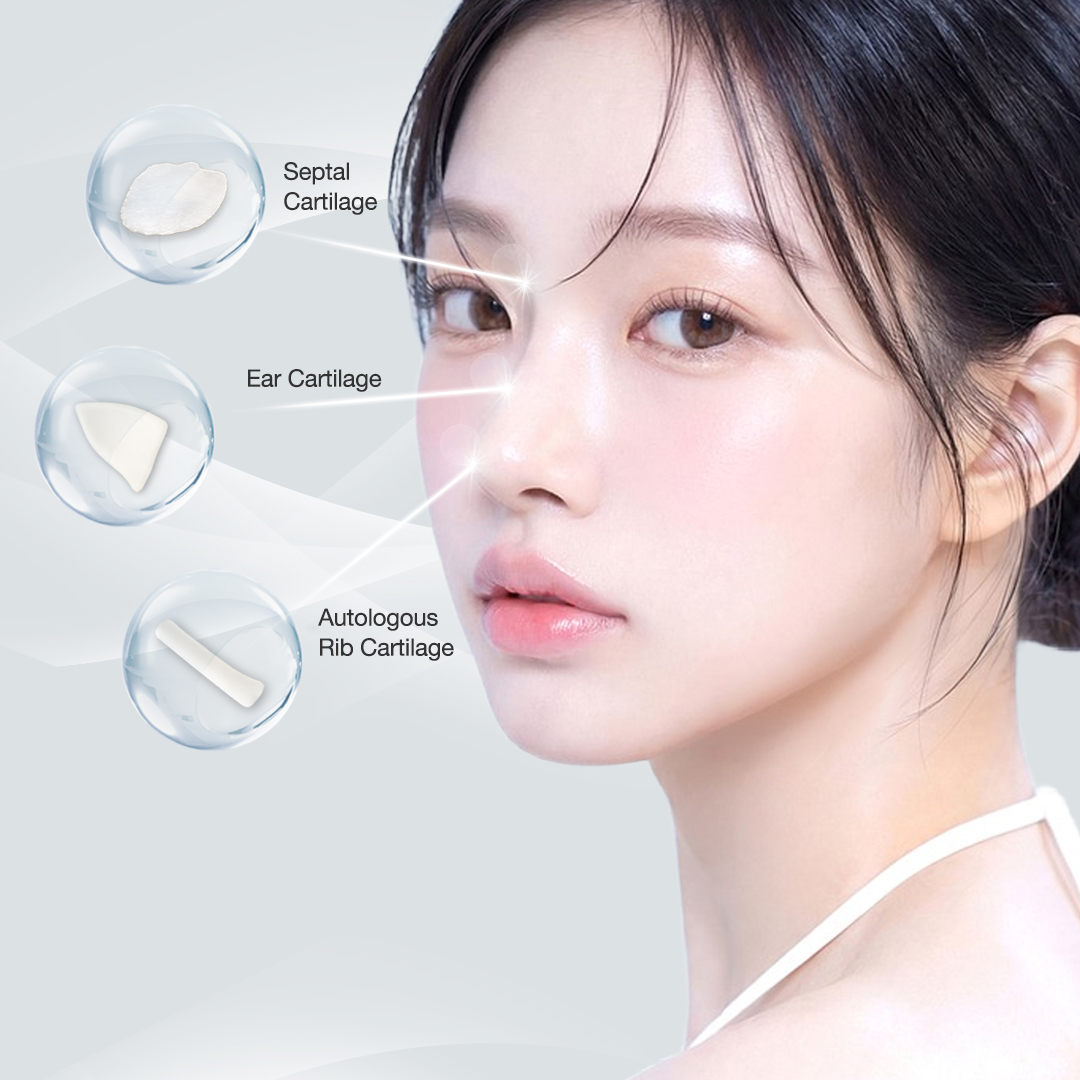
Cartilage harvested from your own body (septal, costal or ear cartilage) is finely minced into particles, then mixed with a fibrin concentrate extracted from your own blood. It is shaped either into a silicone-like form or a syringe-injectable form — which is why the procedure divides into an open and a non-incision approach.
Open vs. injection — a comparison
Material
Profile
Surgery time
Recovery
Open (cartilage rhinoplasty)
Autologous cartilage, silicone-shaped
Higher bridge & tip projection
3 hours
7+ days
Non-incision (cartilage injection)
Autologous cartilage, injected
Natural bridge & tip
30 minutes
3 days
Why cartilage particles?
The materials most commonly used in rhinoplasty are implants such as silicone and dermal grafts.

With silicone
It is not absorbed, but the risk of inflammation is high, and over time it can cause serious complications such as visibility, protrusion and contracture.

With dermal graft
The risk of visibility and inflammation is low, but the absorption rate is very high.
Keeps the strengths of silicone and dermis, fixes their weaknesses
an ideal material

BAROKO cartilage particles
Drawing on 20 years of custom silicone and dermal-graft processing and cartilage-harvesting technique, BAROKO has specialised expertise in processing cartilage into a particle graft material.
01
POINT
Uses your own cartilage —
low rejection risk
02
POINT
Very low risk of
post-op inflammation
03
POINT
Firmer than a dermal graft —
low absorption
Cartilage rhinoplasty — before & after
Dermal graft — before & after
Bridge: no implant / Tip: ear cartilage + dermal graft


Cartilage particle graft — before & after
Bridge: no implant / Glabella: costal cartilage particles / Tip: costal cartilage + particles


BAROKO cartilage particles have a low absorption rate, so the shape holds well. Because the particles can be built into a silicone-like form, they can even raise the bridge — something previously impossible without an implant.
Cartilage particles — fixing the weaknesses of conventional implants
Conventional silicone rhinoplasty

Inflammation is possible
Contracture can follow inflammation
Tip deformity can occur
BAROKO micro-particle autologous cartilage

Low risk of inflammation
No cartilage warping
Holds for years with no tip deformity

BAROKO SPECIAL
Rhinoplasty only,
20+ years of
deep experience
Dr. Jun Kim, Head Surgeon
What makes BAROKO cartilage particles special
A particle graft demands meticulous work, from harvesting the cartilage to processing it.
Dr. Kim performs every step before and after surgery, processing a custom particle graft matched to each patient’s facial balance. Natural, beautiful results and safety, always first — that is BAROKO’s goal.
What makes BAROKO rhinoplasty different
BAROKO takes exceptional pride in rhinoplasty.

01
Precise pre-op screening
University-hospital-grade 3D-CT imaging before surgery for a detailed assessment.

02
Systematic analysis & 1:1 consultation
After 3D-CT imaging, the internal nasal dimensions and any disease are analysed, followed by a thorough consultation.

03
A nose-focused ENT surgeon
An ENT surgeon specialising in the nose — combining function and aesthetic sense.

04
Virtual surgery system
Virtual surgery before the operation produces a predictable, accurate result.

05
No artificial material
No synthetic material or donor cartilage — only autologous cartilage, lowering the inflammation rate.

06
Operated by the director, 20+ years
Extensive clinical experience focused only on the nose, creating a line in harmony with the face.

07
A commitment to safe surgery
A large sterile operating room blocks infection; ultrasound guidance supports safe anaesthesia.

08
Core technical capability
BAROKO holds differentiated technique in facial-line rhinoplasty.

09
Surgery warranty issued
As a matter of pride, BAROKO issues a surgery warranty and provides thorough aftercare.

10
Systematic aftercare
BAROKO’s own structured aftercare takes responsibility for recovery from bruising, scarring and swelling.

11
Detailed follow-up checks
Follow-ups compare before and after in detail, and progress is checked closely — patients report high satisfaction.
Cartilage particle grafts — FAQ
The same method is not applied to every patient. Skin thickness, the structure of the bridge and tip, the height needed, whether there was previous surgery and the condition of your own cartilage are all checked before deciding whether it is suitable.
The two differ in their approach and in how much can be corrected. Your surgeon will guide you to the right method depending on whether structural correction of the bridge and tip is needed, or a more limited change is enough.
Recovery depends on whether the approach is open or non-incision and on the extent of correction. Swelling, bruising and discomfort at the harvest site also vary between individuals, so the exact schedule of visits and return to daily life is best confirmed once the surgical plan is set.